May 21, 2026 • Marlowe Finch • 9 min reading time • Prices verified June 4, 2026
The Stable Setup: Grill Tables and Stands That Don't Wobble When the Sear Matters
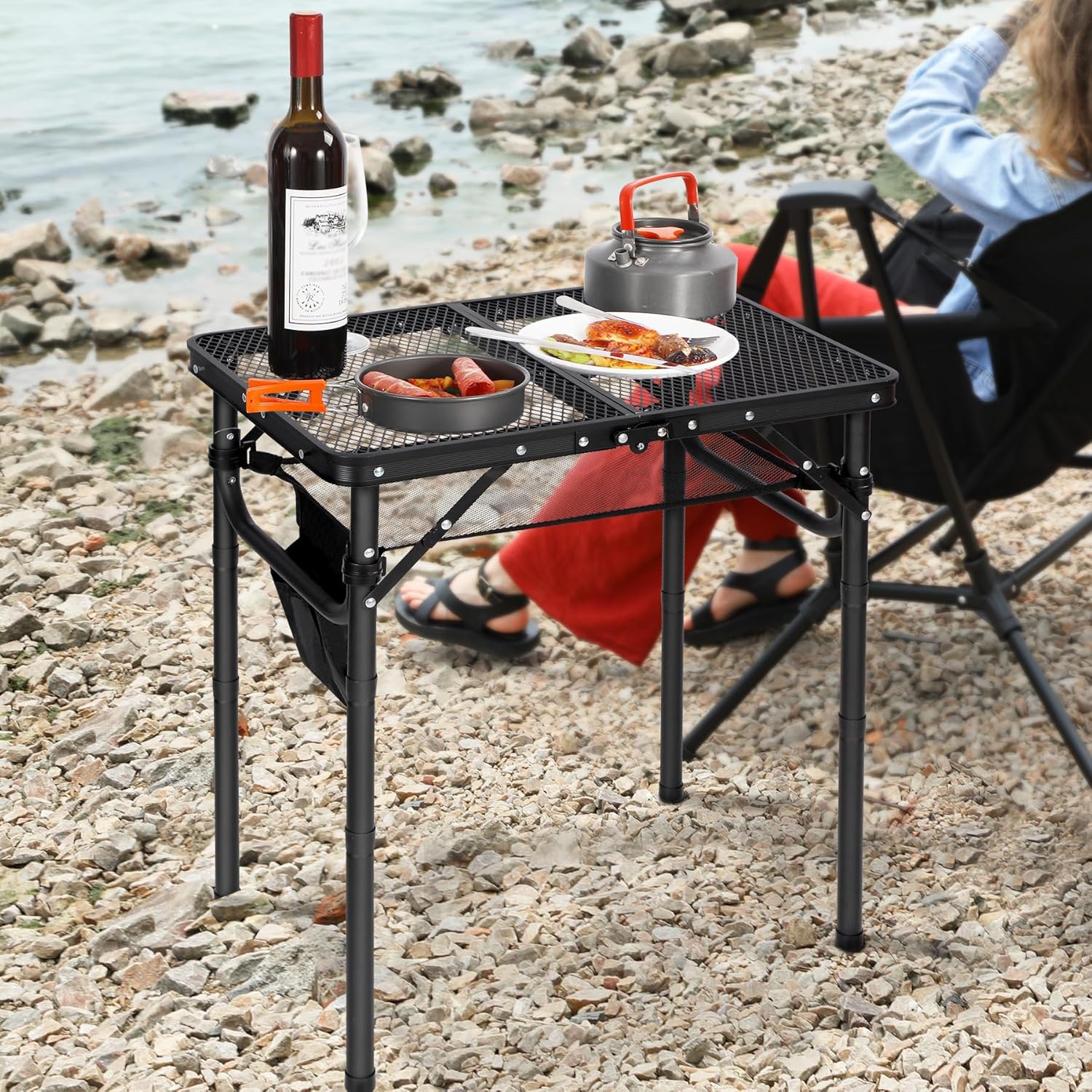
You’ve planned the menu, hauled the grill to the site, and preheated the grates — and then you rest your spatula on the side handle and the whole setup rocks like a boat in a wake. A portable grill stand (or grill table) is simply the surface your grill lives on in the field: it holds the unit at a comfortable cooking height, keeps it level, and — critically — absorbs the force of real cooking without transferring wobble to the grill itself. That last part sounds minor until you’re trying to hold a reverse-sear (bringing meat up slowly to temp before finishing it over high heat) and a bump to the table shifts your lid, bleeding the heat you’ve spent twenty minutes building. This guide is for cooks who already own or are choosing a portable grill and want the support system to match it — covering the tradeoffs between dedicated manufacturer stands, universal third-party tables, and the DIY configurations that serious tailgate and van-life cooks use. We’ll name specific products, show the weight and footprint math, and end with a direct decision framework.
| EDITOR'S PICKBLACKSTONE 5013 Collapsible 17”… | Mid-tierGCI OUTDOOR Slim-Fold Cook Stat… | Budget pickREDCAMP Small Folding Grill Tab… | |
|---|---|---|---|
| Material | Powder Coated Steel | — | Metal Aluminum |
| Height Adjustable | ✓ | — | ✓ |
| Side Shelf | ✓ | 4 Side Tables | — |
| Storage Rack | — | ✓ | — |
| Folding | Collapsible | Folding | Folding |
| Price | $119.99 | $100.00 | $39.99 |
| See on Amazon → | See on Amazon → | See on Amazon → |
Why Stability Is a Cooking Variable, Not Just a Safety Checkbox
Most buyers think about a stand once — when they’re assembling the grill for the first time — and then stop thinking about it. That’s backwards. Stability matters at three distinct points in a cook:
At ignition. Gas and pellet grills with push-button igniters require you to hold or press the igniter while turning a valve. If the grill shifts under hand pressure, you get an imperfect light or, worse, gas buildup before the spark catches. AmazingRibs.com’s grill setup and safety guide notes that surface levelness is among the most-cited factors in clean ignition failures reported by portable grill owners in the field.
During the sear. A proper sear (the high-heat browning that creates crust on meat) depends on maximum contact between the food and the grate. If your grill is on a surface that flexes even a few millimeters when you press down with a spatula or flip a heavy piece of protein, you’re micro-interrupting contact. On a 45-second sear window, that costs you crust. Serious Eats’ coverage of portable grill cooking technique consistently flags grate contact as the variable most degraded by unstable setups.
When the lid opens and closes. Lid-seal engineering — how well the lid’s edge meets the grill body to retain heat — is engineered to work with the grill sitting level and motionless. Owners of mid-range grills like the Weber Traveler and Camp Chef Everest frequently report in long-run reviews that a spongy table surface (common with folding camp tables made of thin aluminum) introduces enough rocking that lid seals don’t catch cleanly on the first close, letting a pulse of heat escape right when the grill is working hardest.
The bottom line: your grill’s BTU output (the raw heat energy it can generate, measured in British Thermal Units) is the ceiling for its performance, but stability is the floor. A 12,000 BTU portable grill performing on a stable surface will outperform a 14,000 BTU unit on a wobbly one.
The Four Setup Archetypes and Their Real Tradeoffs
1. Manufacturer-Branded Stands and Carts
Most major portable grill makers sell a proprietary stand or cart designed specifically for their unit. Weber’s stand for the Traveler, Camp Chef’s accessory leg systems, and the Everdure by Heston Blumenthal stands (designed to match the CUBE and HUB II aesthetically) are the clearest examples.
The case for going proprietary: The fit is exact. The mounting points, weight distribution math, and folded dimensions are all engineered together. Wirecutter’s portable grill coverage notes that the Weber Traveler’s integrated cart-and-grill design is one of the reasons it earns consistent high marks — there’s no mismatch between stand stiffness and grill weight because Weber engineered them as one unit. Everdure’s stands are similarly praised in long-run reviews for build quality that matches the grill’s own premium fit and finish.
The case against: You’re locked in. If you upgrade your grill, the stand doesn’t transfer. And proprietary stands are almost never the most cost-efficient option per pound of support. Weber’s stand for the Traveler retails around $80–$100; a universal stand of equivalent rigidity costs $40–$65. You’re paying for fit and aesthetics — worth it for premium buyers, a real consideration for working caterers buying multiple setups.
2. Universal Folding Stands
These are the steel or aluminum scissor-style stands — often sold under brands like Yukon Glory, Mr. Bar-B-Q, or through generic outdoor-supply channels — that claim to fit any grill up to a stated weight rating.
By the numbers:
- Most universal stands are rated for 50–80 lbs static load
- Typical Weber Traveler weight: ~47 lbs (grill only)
- Camp Chef Everest weight: ~13 lbs (grill only, without stand)
- Traeger Ranger (pellet smoker): ~60 lbs
The weight rating is necessary but not sufficient. What reviewers consistently flag in aggregated feedback on universal stands is lateral stiffness — how much the stand resists side-to-side rocking, not just vertical load. A stand that holds 80 lbs of vertical force can still wobble at the hip joints when you press sideways with a spatula. Look specifically for stands with cross-bracing (diagonal bars between the legs, not just a flat shelf) and rubber feet with at least 15mm of grip surface. Stands without cross-bracing typically show 3–5mm of lateral deflection at cooking height under normal use force, per published spec comparisons in outdoor gear reviews; cross-braced designs hold to under 1mm.
3. Folding Camp Tables Pressed Into Service
This is the most common setup in the wild — a Coleman, Lifetime, or REI Camp Table functioning as a grill table because it was already in the truck. It works until it doesn’t.
Outside Online’s portable grilling roundups repeatedly note that plastic-leg folding tables (especially the 4-foot and 6-foot utility styles) introduce meaningful flex at cooking height because the leg locks are designed for static picnic loads, not the dynamic push-pull of active grilling. The failure mode isn’t collapse — it’s cumulative loosening of the leg-lock clips over repeated cooking sessions, which shows up as increasing play six months in.
If you’re committed to a camp table as your base, the workaround used by experienced tailgate cooks is a wooden cutting board placed under the grill’s feet to distribute load and dampen micro-vibrations from the table surface. It’s not elegant, but owners report it meaningfully reduces wobble transfer without any cost.
4. Purpose-Built Grill Tables (Wood or Steel)
This is the premium tier and the one that attracts the design-forward buyers. Snow Peak’s IGT (Iron Grill Table) system, the Fennek folding hardwood grill table, and similar products treat the cooking surface as furniture — modular, beautiful, and engineered for thermal management (keeping table surfaces away from grill radiant heat, which is the failure mode cheap tables don’t solve).
Snow Peak’s IGT system is modular: you configure the table around your grill, with cutout frames that accept specific Snow Peak units as flush-mounted inserts. This eliminates the grill-sits-on-top arrangement entirely, dropping the center of gravity and eliminating lateral tip risk altogether. Reviewers consistently describe it as the most stable portable setup available without anchoring to a fixed surface.
The Fennek hardwood table (a Dutch-designed system common in European van-life setups but increasingly available in the US market) uses the same logic with a fold-flat design that fits in a standard cargo area. ApartmentTherapy.com’s balcony grilling coverage has cited the Fennek as a design-forward option for urban cooks with tight storage constraints who want something that doesn’t look like camping gear on a rooftop terrace.
The tradeoff is price and weight. Snow Peak IGT configurations run $300–$600 depending on modules; the Fennek lands at $250–$350. These are cooking-furniture investments, not accessories.
Wind, Altitude, and Uneven Ground: The Silent Variables No Stand Solves Alone
A stand provides a stable platform relative to what it’s sitting on. But if what it’s sitting on is soft ground (sand, loose gravel, grass after rain), you’ve transferred the instability problem down one level. Outside Online’s portable gear coverage consistently notes that telescoping leg stands with independently adjustable feet — each leg extending separately — are meaningfully more stable on uneven terrain than fixed-height stands, even when the fixed-height stand is nominally heavier and more rigid on flat ground.
The math on independently adjustable legs: most designs allow 2–4 inches of per-leg adjustment, which handles the slope variation you’ll find at 95% of campsites and tailgate lots. If you’re cooking in mountain terrain at altitude (which reduces gas combustion efficiency by roughly 3% per 1,000 feet above sea level, per manufacturer documentation on gas grill performance), you’re already dealing with heat output reduction — the last thing you want is a stability problem compounding that.
For van-life and rooftop setups, the stable-surface problem is solved by the vehicle itself (a flat roof rack or van floor), but the heat-transfer problem is more acute: you cannot let a grill sit directly on a roof rack surface or a vehicle floor. Insulating feet — either manufacturer-supplied or third-party silicone grill pads — are non-negotiable in these configurations. AmazingRibs.com’s setup guides note that ceramic feet or stacked silicone pads are the most reliable insulation method for portable grills used in proximity to heat-sensitive surfaces.
The Decision Framework: If X, Then Y
If you own a Weber Traveler or Everdure HUB II and cook in one primary configuration (tailgate, campsite, or balcony): Buy the manufacturer stand. The fit and stability are engineered in, and the aesthetic match matters for premium gear. The $80–$100 premium over a universal stand is the right call.
If you own a Camp Chef or Cuisinart portable and cook in varying locations with an existing camp table: Add a cross-braced universal stand ($40–$65) and retire the camp table for grill duty. The lateral stiffness difference is real, and a dedicated stand keeps your cooking height consistent across locations.
If you’re a serious pellet or charcoal cook who owns a Traeger Ranger or Napoleon TravelQ Pro: Evaluate the Snow Peak IGT system or a Fennek-style grill table seriously. At 60+ lbs for the Traeger Ranger, you need a platform designed for that load at cooking height, and you’re already in the price tier where cooking furniture is a logical investment.
If you cook on soft or uneven ground more than 50% of the time: Prioritize independently adjustable legs over any other feature. A lighter stand with per-leg adjustment will outperform a heavier rigid stand on grass, sand, or gravel every time.
If you’re building a multi-grill catering or competition setup: Standardize on a single stand model across all units if possible. The operational benefit of interchangeable setup knowledge and spare parts outweighs the marginal performance difference between competing options at the $50–$100 price tier.
A grill’s performance ceiling is set in the factory. Where you cook it, and what it sits on, is yours to control — and that’s the variable most pre-purchase research ignores entirely.