April 14, 2026 • Marlowe Finch • 9 min reading time • Prices verified June 4, 2026
Grill and Griddle in One: The Portable Combo Rigs That Replace Two Pieces of Gear
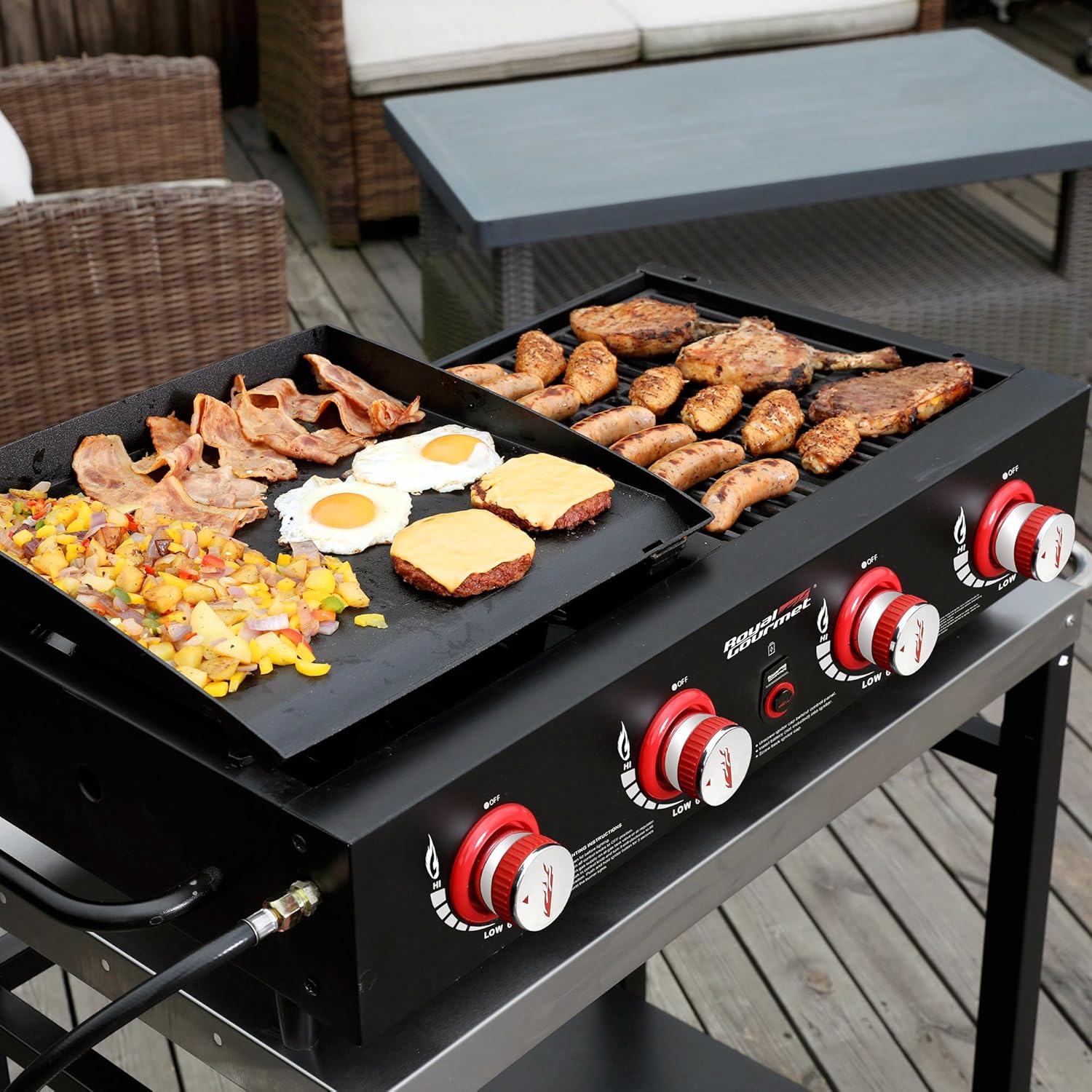
If you’ve ever wished you could cook eggs and bacon in the morning and then throw a ribeye over real flame that same afternoon — without hauling separate pieces of gear — a portable grill-griddle combo is the answer to that problem. Here’s the plain-language version of what these rigs do: a grill uses open grates to cook food over direct heat, leaving char marks and letting fat drip away. A griddle is a flat, solid cooking surface — think diner-style flat-top — that holds heat evenly across the whole plate, perfect for eggs, smash burgers, pancakes, or anything that would fall through grates. A combo unit gives you both cooking surfaces on one frame, often by swapping or flipping a reversible insert. That sounds simple. The buying decision is not. This guide breaks down how these rigs actually work, what you give up to get the versatility, and which formats make sense for which kind of cook.
| EDITOR'S PICKRoyal Gourmet PD3001 3-Burner P… | Mid-tierRoyal Gourmet GD4002T 4-Burner… | Budget pickColeman 4-in-1 Portable Propane… | |
|---|---|---|---|
| BTUs | — | 40000 | 7000 |
| Burners | 3 | 4 | — |
| Cooking area | 314 sq. in. | — | — |
| Included attachments | — | — | 4 |
| PFAS-free | — | — | ✓ |
| Price | $199.99 | $174.11 | $122.99 |
| See on Amazon → | See on Amazon → | See on Amazon → |
Why the Combo Concept Is Harder Than It Looks
The fundamental engineering tension in any grill-griddle combo is heat distribution. A grill grate is designed to concentrate heat at contact points — that’s how you get a sear. A griddle needs the opposite: even, wall-to-wall heat with no hot spots, so the pancake at the edge cooks at the same rate as the one in the center. Achieving both modes on the same burner layout is genuinely difficult, and the cheaper rigs punt on one or the other.
The second problem is surface mass. A quality griddle plate — the kind that holds temperature when you drop a cold burger patty onto it — needs meaningful thickness. Cast iron runs heavy (a 17-inch cast-iron griddle plate alone weighs 8–12 lbs). Rolled steel (also called carbon steel or cold-rolled steel) is lighter and seasons similarly to cast iron but requires a break-in period and is less forgiving of neglect. Most portable combos use thinner steel plates to keep weight down, and owners on long-run reviews at sites like Amazing Ribs consistently note that thin plates lead to temperature spikes and recovery lag — exactly what you don’t want mid-cook.
Third: the swap mechanism itself. Reversible grate-to-griddle systems work well when the plate sits flush and locks in. When it doesn’t, you get wobbly surfaces, grease channels that drain the wrong direction, and a cleanup scenario that belongs in a cautionary tale. Reviewers at Wirecutter’s portable grill roundups have flagged this specifically on mid-range combo units — the grate-to-griddle conversion that looks elegant in the product video becomes a greasy puzzle at the campsite.
None of this means you should avoid combos. It means you should know what you’re buying before you buy it.
The Four Formats Worth Knowing
Portable grill-griddle combos cluster into four recognizable formats. Each makes a different tradeoff.
1. Reversible grate-griddle inserts (gas) The most common format. A two-burner propane unit ships with a grate on one side of the cooking surface and a griddle on the other. You flip or swap the insert to change modes. Camp Chef’s Explorer series and their flat-top accessories live here, as does the Blackstone Dash lineup. The upside: genuine versatility, with both surfaces available to any cook who plans ahead. The downside: you’re limited to one mode at a time unless you buy a unit wide enough to run both simultaneously (which most sub-$300 rigs are not).
2. Side-by-side half-grate, half-griddle (gas) Some two-burner rigs split the cooking surface down the middle — one burner under a grate, one under a solid griddle plate, running simultaneously. This is the format serious camp cooks actually want, because you can sear protein on one side while holding vegetables or eggs on the other. Weber’s Spirit series offers this split-surface approach in a portable footprint; so does the Cuisinart Twin Oaks pellet-and-gas hybrid (though that unit is pushing the upper boundary of “portable” at around 60 lbs). The tradeoff is that each half-surface is genuinely small — often 150–200 square inches per zone — which constrains batch size.
3. Removable griddle tops on charcoal kettles A smaller category but worth flagging for the charcoal-committed crowd. Brands including Lodge and some third-party accessory makers sell cast-iron griddle plates sized to sit over standard kettle openings. This gives your existing portable kettle a griddle mode without buying a new unit. The limitation is obvious: charcoal heat is less controllable than gas, and achieving the even temperatures a griddle needs requires more skill and patience. Reviewers at Serious Eats have consistently noted that charcoal griddle cooking rewards experienced users but frustrates beginners expecting gas-level predictability.
4. Dedicated flat-top portables with grill grate accessories The inverse of the insert approach: a unit designed primarily as a griddle (think Blackstone 17” or the Camp Chef Flat Top 600 in its portable configuration) that accepts a grill grate accessory. These tend to perform better as griddles — because that’s what they were engineered to be — but the grill grate add-on is often an afterthought. Outside Online’s camp grill coverage has noted that dedicated flat-tops excel at the griddle task but rarely match a purpose-built grill for high-heat searing.
The Numbers That Actually Matter
Before getting to recommendations, anchor yourself to a few specs reviewers at Amazing Ribs and Serious Eats consistently return to when evaluating combo portables:
Quick reference — what to look for on the spec sheet:
| Spec | Minimum for serious use | Why it matters |
|---|---|---|
| BTU output (gas) | 12,000 BTU per burner | Drives griddle recovery after cold food is added |
| Griddle plate thickness | 3mm+ rolled steel or cast iron | Thinner plates produce hot spots and slow recovery |
| Total cooking area | 280 sq in+ for two people | Half-and-half split shrinks usable area fast |
| Folded weight | Under 40 lbs for car camping | Over 50 lbs requires two people to move safely |
One number manufacturers reliably bury: BTU-per-square-inch. Divide total BTU by total cooking area and you get a better picture of actual heat density than the raw BTU figure alone. A 20,000 BTU unit spread across 500 square inches delivers 40 BTU/sq in. The same 20,000 BTU across 300 square inches delivers 66 BTU/sq in — a meaningfully hotter surface for searing. Per published specs on models widely reviewed as of mid-2026, the Camp Chef Flat Top 600 and the Weber Traveler (with optional griddle plate) both land in the 50–70 BTU/sq in range on their primary cooking zones, which is competitive for the portable class.
What You Actually Give Up
This is the tradeoff section most buying guides skip, so here it is plainly:
Sear quality. A dedicated grill — grates, open flame, fat dripping away — produces a better sear than any combo unit running a reversible insert. The insert traps some heat, changes airflow, and rarely sits at true grate height. Owners of combo units consistently report this in long-form reviews: the sear is good, not great. If your primary use case is steakhouse-level sear marks on thick-cut proteins, a dedicated portable grill outperforms any combo at the same price point.
Griddle consistency. Dedicated flat-tops from Blackstone and Camp Chef have been refined over years of owner feedback into genuinely even-heating surfaces. Most combo units are not that refined. The griddle side is capable, but it won’t match a dedicated flat-top for edge-to-edge temperature consistency.
Cleanup. Two cooking surfaces mean two cleanup protocols. A griddle needs scraping, seasoning, and grease management. Grates need brushing and a different kind of maintenance. When both surfaces are dirty, cleanup time doubles. Operators who have run combo units at tailgates and camp setups consistently flag this as the hidden labor cost of the versatility.
Packed size and weight. A capable combo rig typically runs 35–55 lbs and folds to dimensions that fit a truck bed or SUV cargo area comfortably but will not fit a Civic trunk without removing the grill entirely. If you’re weight-limited — backpack-adjacent camping, motorcycle touring, rooftop rack with tight capacity — a combo is almost certainly the wrong answer, and a single-purpose, ultra-compact unit serves better.
If X, Then Y: The Decision Rules
You’ve read the tradeoffs. Here’s how to apply them to your actual situation.
If your cook group runs 4+ people and you cook both egg-style breakfasts and grilled mains on the same trip: A side-by-side half-grate/half-griddle gas unit is worth the weight penalty. The simultaneous cooking surface is the only format that lets one person run both modes without breaking down and reconfiguring mid-service. Look at the Camp Chef Explorer two-burner series with the sidekick griddle attachment or the Weber Spirit in its portable-format configurations.
If you cook mostly grilled proteins but want occasional griddle capability: A primary grill unit with a high-quality aftermarket griddle insert (cast iron or thick carbon steel, not the thin stamped-steel inserts that ship as accessories) beats a dedicated combo at the same price. You’ll spend $30–$60 on the insert and get better results than a purpose-built combo’s griddle mode.
If you cook mostly griddle food but occasionally want grill marks: Buy a dedicated flat-top portable. Add a grill grate accessory only if you cook grilled protein more than twice a season. The math doesn’t favor carrying a grill grate accessory that you use four times a year.
If you’re a small-scale caterer or event cook building a portable setup: The combo format is genuinely valuable here because you’re cooking for variety — bacon for one customer, a burger for another — and you need the flexibility more than the peak performance of either surface. Camp Chef’s professional-grade flat-top rigs with grill grate accessories have a strong operator following in exactly this context, per coverage at Amazing Ribs and feedback in the competitive BBQ circuit community.
If weight and packed size are your binding constraints: Neither a dedicated combo rig nor a large flat-top is your answer. A compact single-surface unit — a Lodge cast-iron hibachi for charcoal flexibility, or a single-burner propane grill under 20 lbs — serves the constraint better. Versatility costs weight. Always.
The Bottom Line
Portable grill-griddle combos solve a real problem for the cook who genuinely needs both surfaces on the same outing. The best units in this category — the side-by-side format gas rigs with serious BTU output and plate thickness above 3mm — deliver on that promise competently, if not perfectly. What they don’t do is match a purpose-built grill at grilling or a dedicated flat-top at flat-top cooking. That’s not a flaw. It’s the definition of a tradeoff, and it’s only a problem if you buy a combo unit hoping it will outperform a dedicated rig on its home turf.
The honest question to ask yourself before buying: on a typical trip, do you actually need both surfaces — or do you just like the idea of having them? If it’s the former, the combo earns its weight. If it’s the latter, simplify, and spend the savings on better fuel management or a quality cover that extends the life of whichever single-purpose rig you choose.