May 2, 2026 • Marlowe Finch • 9 min reading time • Prices verified June 4, 2026
Light It Right: The Charcoal Chimney Starter Guide for Portable Grill Cooks
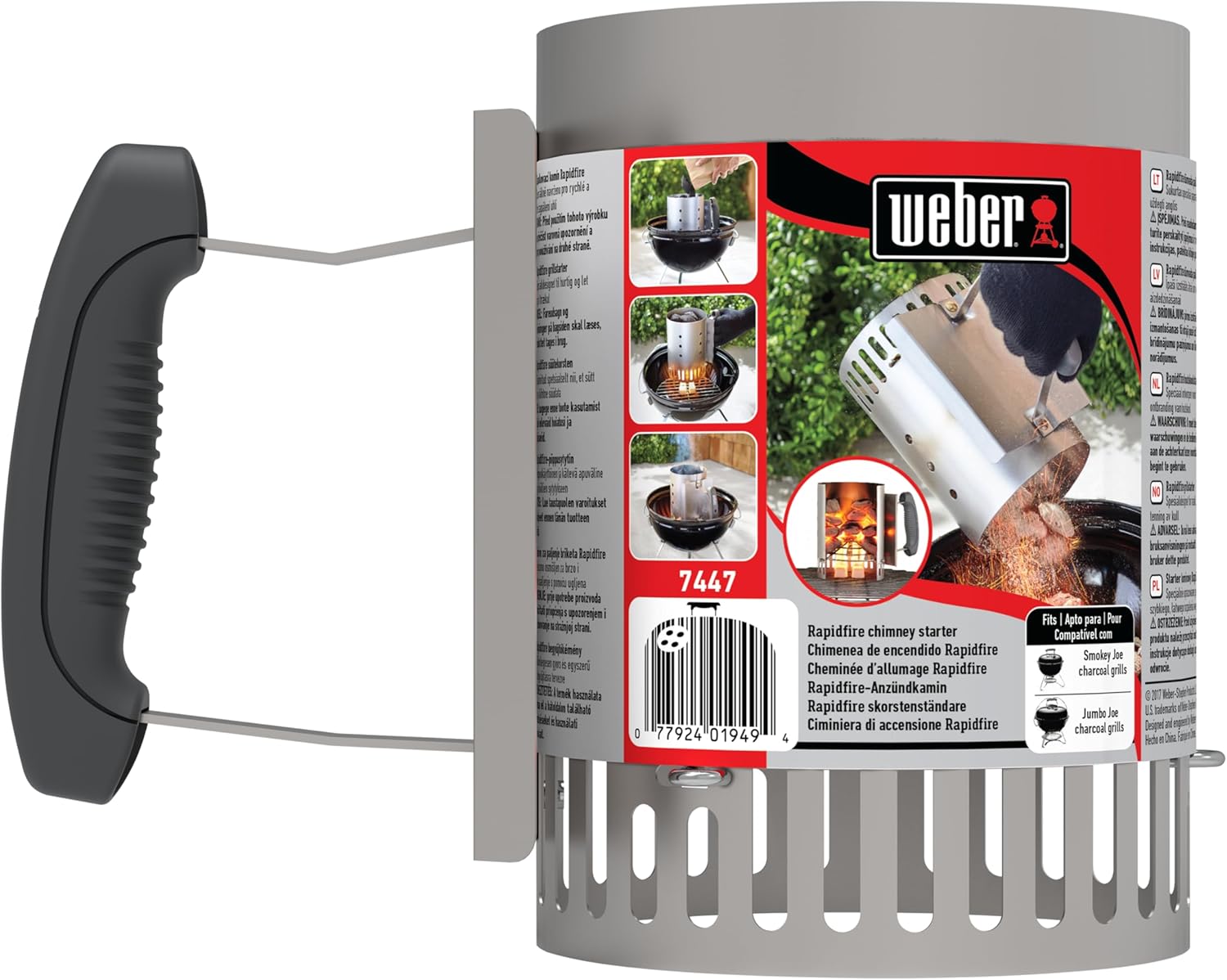
A charcoal chimney starter is a simple metal cylinder — open at both ends, with a grate inside — that lets you get a full load of charcoal glowing orange and ready to cook in about 15 minutes, using nothing but a single sheet of newspaper or a paper towel. You set it on the lower grate of your grill, stuff the bottom with paper, fill the top with charcoal (the solid black lumps or pressed briquettes you burn for heat), light the paper, and walk away. By the time you’ve prepped your ingredients, the coals are ashed over and screaming hot, with zero lighter-fluid chemical taste left on your food. If you’re cooking on a portable charcoal grill — a compact kettle, a hibachi, a Camp Chef or Weber travel rig — a chimney starter isn’t optional gear. It’s the difference between a controlled, confident cook and a 45-minute lighter-fluid fumble that still leaves cold spots. This guide walks through how to choose the right chimney size for a portable setup, what separates a good one from a cheap one, and the exact math for never running out of ready coals mid-session.
Why Chimney Size Is the Whole Decision
Most buying guides treat chimney starters as interchangeable. They’re not — at least not for portable grill cooks. The core variable is capacity, measured in quarts or briquette count, and it has to match your grill’s firebox (the area where you actually burn the charcoal) or you’ve wasted money in one direction or the other.
The standard full-size chimney — the Weber Rapidfire, the OXO Good Grips, the Char-Broil — holds roughly 100 briquettes (about 6 quarts). That’s the right load for a 22-inch backyard kettle. But run that same load into a Weber Traveler’s compact firebox or a hibachi with a 10-inch grate and you’ve got coals spilling out, uneven airflow, and a sear surface that runs so hot on one side it incinerates your cook. Wirecutter’s charcoal chimney review notes explicitly that smaller grills benefit from a half-chimney load — or a purpose-built smaller cylinder — to keep heat distribution manageable.
The working size tiers for portable grills:
| Grill type | Firebox area | Right chimney load |
|---|---|---|
| Hibachi / compact cast iron (Lodge, etc.) | 80–120 sq in | ½ chimney (~50 briquettes / 3 qt) |
| Mid-size travel kettle / Traveler-style | 200–250 sq in | ¾ chimney (~75 briquettes) |
| Full-size portable (Camp Chef, Napoleon TravelQ) | 285–330 sq in | Full standard chimney |
Serious Eats’ chimney roundup reinforces this framework, recommending that cooks match the chimney volume to roughly 70–80 percent of their grill’s firebox capacity to leave room for a two-zone setup — meaning one hot side for searing and one cooler side for finishing — rather than flooding the entire grate with coals.
The practical takeaway: if your primary grill is a hibachi or a sub-200-square-inch compact, buy a half-size chimney (the Weber Rapidfire 3-quart compact, or any roughly 3-quart cylinder) and use it full. If you run a Weber Traveler or similar mid-size portable, a standard 6-quart chimney used at two-thirds capacity gives you more control than a small chimney maxed out.
What Actually Makes One Chimney Better Than Another
Once you’re in the right size tier, the build details are what separate a chimney you’ll still be using in year five from one you throw out after a summer.
The grate inside the cylinder is the most failure-prone part. Cheap chimneys use a stamped-steel disk with small holes; over multiple heat cycles, these warp and sag, restricting airflow and turning a 15-minute light into a 25-minute one. Better chimneys — the Weber Rapidfire, the OXO model — use a rolled-steel cone or a rigid expanded-metal grate that holds its shape through seasons of use. Amazing Ribs’ chimney science piece notes that consistent airflow from bottom to top is the entire mechanism of a chimney starter; anything that restricts it (a warped grate, a dented lower chamber) slows the light and produces uneven coal readiness.
The handle and heat shield matter more on a portable setup than on a backyard rig, because you’re often working at a lower height — on a tailgate, a folding table, a van step — which puts your hand closer to the rising heat column. The OXO Good Grips has a heat-resistant rubberized handle plus a secondary folding steel handle that reviewers consistently call out as the feature that makes a confident pour. Wirecutter’s testing summary (based on aggregated owner and lab data) identifies the dual-handle design as the single biggest usability differentiator between full-size chimneys.
The bottom combustion chamber — the space below the grate where you put the paper — should be wide enough to use a folded newspaper quarter or a single paper towel easily. Some budget chimneys have such a narrow lower opening that you’re cramming paper in with a stick. That’s a minor inconvenience at home. At a campsite at dusk, with one hand on a headlamp, it’s genuinely annoying.
Portability-specific note: A chimney starter is not a compact item. A standard 6-quart chimney is roughly 12 inches tall and 6 inches in diameter. That fits fine in a Subaru cargo bay next to a Weber Traveler; it does not fit inside most portable grill carry bags. Van-lifers and ultralight campers often carry a half-size chimney specifically because it tucks into the side of a grill bag or the outer pocket of a large pack. Outside Online’s camp cooking essentials guide lists the half-size chimney as a camp cook’s non-negotiable precisely for this stowage reason.
The Lighting Math: Coals, Time, and Wind
Here’s where portable-specific conditions change the standard advice. A chimney that lights in 15 minutes in a suburban backyard may take 22–28 minutes at elevation or in a headwind. Cook’s Illustrated’s charcoal lighting guide (based on controlled heat comparisons) documents that airflow restriction — either from wind interference or altitude reducing oxygen density — is the primary driver of extended light times. The chimney works by convection: hot air rises through the coal column and pulls fresh air in from the bottom. Anything that disrupts that column slows everything down.
By the numbers:
- Sea level, no wind: chimney ready in ~15 min
- 5,000 ft elevation (Rocky Mountain camping, common trailhead scenario): add 5–8 min
- 10–15 mph crosswind without a windscreen: add 6–10 min, coals may light unevenly
- Combined elevation + wind: budget 30–35 min; light two sheets of paper instead of one
The practical fix is a windscreen: simply orient the chimney so its lower vents face into the wind rather than away from it, or build a loose three-sided wall of rocks or a folded reflective panel (the kind used for camping stoves) around the base. This is the same principle that serious portable stove users apply to camp stoves at altitude — the chimney starter is just a bigger version of the same combustion physics.
Fuel type also changes your math. Lump charcoal (irregular wood-derived chunks, burns hotter and faster) lights in a chimney about 20 percent faster than briquettes (compressed charcoal with binders, burns more evenly and longer). Amazing Ribs’ fuel comparison data puts lump ready-to-cook time at 10–12 minutes in a standard chimney versus 15–18 for quality briquettes like Kingsford Original. For a quick weeknight tailgate cook where you want to be eating in 45 minutes total, lump in a chimney is the fastest legitimate path. For a two-hour low-and-slow session on a pellet-style portable, briquettes’ longer burn gives you a more stable heat bed.
Decision Rules: Which Chimney for Which Setup
If you’ve read this far, you know the variables. Here’s the clean if/then frame:
If you cook on a hibachi, a Lodge cast-iron compact, or any grill under 150 square inches of grate: buy a half-size chimney (3 qt / ~50 briquette capacity). Use it full every session. The Weber Rapidfire compact and the OXO half-size are the two most recommended by aggregated reviews. Do not use a full-size chimney at half-fill — the airflow geometry doesn’t work as well as a correctly-sized cylinder filled to the top.
If you cook on a Weber Traveler, a portable 18-inch kettle, or a Camp Chef mid-size: a standard 6-quart chimney used at 60–75% capacity is your best tool. The Weber Rapidfire Deluxe (the standard, widely-available version) is the benchmark here — owners consistently report the dual-handle design and the rolled-steel interior grate holding up through multi-season use without warping.
If you cook at elevation or in consistently windy conditions (camping, rooftop, exposed tailgate): prioritize a chimney with a wide lower combustion chamber (easier to load two sheets of paper) and plan your lighting time with the altitude/wind buffer above. A portable windscreen — the folding aluminum type sold for camp stoves — is worth carrying specifically for chimney use.
If portability and stowage are your primary constraints (van-lifer, ultralight camper, anyone whose grill lives in a carry bag): go half-size regardless of grill size. Two loads from a half-size chimney equals one load from a full-size, and you can load the second batch while the first is already on the grate getting a two-zone setup going. It adds five minutes to your setup time and saves several inches of pack space.
If you’re gifting this to a premium-grill owner (Traeger Ranger, Everdure HUB II, Napoleon TravelQ Pro): the OXO Good Grips is the one that looks and feels proportional to a $700 grill. Owners who’ve invested in design-forward equipment tend to notice when a $12 stamped-steel cylinder is sitting next to their Everdure — the OXO’s matte-metal finish and rubberized grip hold up aesthetically. It’s a meaningful stocking-stuffer at around $30–$35 retail.
The One Thing Most Buyers Skip
Replacement parts and maintenance. A chimney starter has one moving part — the interior grate — and when it fails, the whole chimney stops working efficiently. Weber and OXO both sell replacement grates; most no-name chimneys do not. At a $12–$15 price point, that’s fine — you just buy a new one. At $30–$40, which is where the OXO and Rapidfire Deluxe land, you should be able to replace the grate rather than replace the whole unit. This is the same long-tail value signal worth asking about a portable grill itself, and it applies equally to the starter that lights it. Before you buy, a quick search for “[brand] chimney replacement grate” tells you whether that option exists.
A chimney starter is a five-year tool if you buy the right one. The math is simple: roughly $35 up front, zero lighter fluid costs, reliable 15-minute lights from the first use to the last. For a portable grill cook who fires up two or three times a month, there’s no better return on a single piece of supporting gear.